Developing the work environment: Practical tips for hybrid work challenges
Developing work environments in the era of hybrid work requires new thinking and planning. Modern workspaces support both remote and on-site work, enabling smooth transitions between them. A functional hybrid work environment considers different working styles, supports collaboration through technology, and provides spaces for both concentration and teamwork. Successful workplace design improves employee experience, increases productivity, and supports the company’s strategic goals.
How has hybrid work changed workplace requirements?
Hybrid work has fundamentally revolutionized workplace design. Office spaces now require flexibility, versatility, and digital compatibility in a way that enables seamless work regardless of location. Employee expectations have changed – people increasingly come to the office for meetings, collaboration, and social interaction, rather than for routine tasks.
The most significant change has occurred in how spaces are used. Instead of traditional workstations, diverse areas are needed for different purposes: meeting places, quiet spaces, relaxation areas, and technologically equipped conference rooms. All of this has brought about the need for adaptability, as the number of employees in the office varies from day to day and week to week.
Technological requirements have also grown. Video conferencing solutions, booking systems, and digital collaboration platforms have become central. The office must support digital collaboration alongside physical spaces, which places new demands on both infrastructure and furniture solutions. The best work environments combine technology and physical space into a seamless whole that supports hybrid meetings and remote participation.
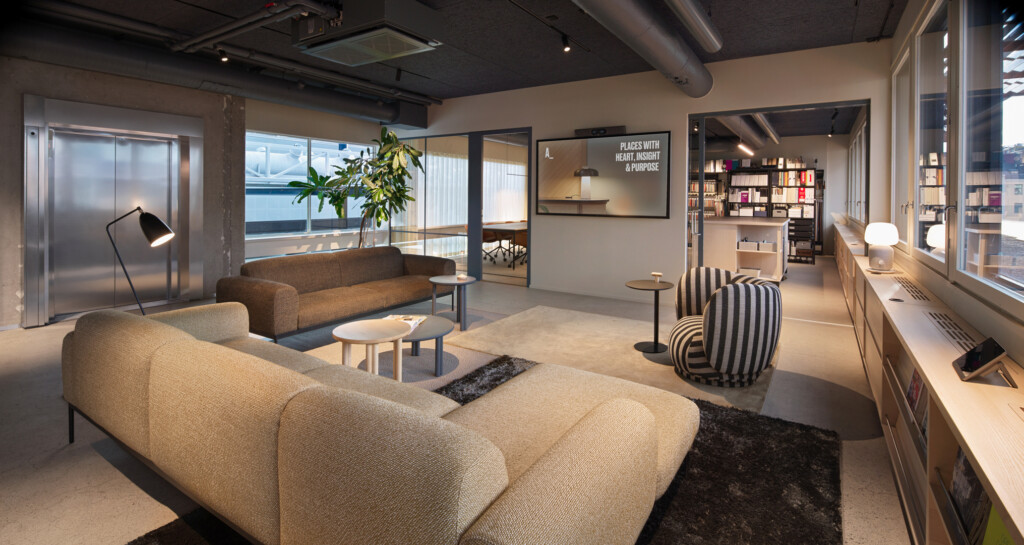
Amerikka’s own office features spaces for multiple purposes.
What are the most important elements of a functional hybrid work environment?
At the core of a functional hybrid work environment is balance between different space types, technological solutions, and work culture. The most important elements form a whole that supports both individual and group work and enables seamless transitions between remote and on-site work. An environment that considers these aspects supports both productivity and workplace wellbeing.
- Diverse space solutions – Collaboration areas, quiet spaces, retreat spaces, and informal meeting places
- Digital infrastructure – Video conferencing spaces, collaboration platforms, and wireless technology everywhere
- Space booking systems – Easy-to-use workstation and conference room reservations
- Adaptive furniture – Adjustable, ergonomic, and convertible furniture solutions
- Meeting-supportive space design – Natural meeting points and areas that enhance community
A successful hybrid work environment also considers the importance of acoustics and lighting. Good sound environment is essential for video conferences and concentration-requiring tasks. Similarly, adjustable lighting that utilizes natural light supports wellbeing and efficiency. All these factors together create the foundation for people to experience coming to the office as valuable.
In workplace design, it’s also important to consider community needs. Functional common areas for coffee breaks and informal meetings are more important than ever in the era of hybrid work. Spaces should encourage spontaneous conversations and knowledge sharing, which are often missing in remote work.
How does the work environment affect employee experience and productivity?
The work environment’s impact on employee experience and productivity is significant and multidimensional. A well-designed space can increase work efficiency when it supports different work tasks and reduces interruptions. The physical environment directly affects concentration, creativity, collaboration, and even stress levels. It also shapes our perception of the employer and our commitment to the organization.
The physical elements of the work environment have a direct impact on wellbeing. Ergonomic furniture reduces physical discomfort, proper lighting prevents eye strain, and good air quality keeps energy levels high. The psychological effects of space design are equally important – the sense of space, connection to nature through windows, and the ability to adjust one’s work environment increase the sense of control and reduce stress.
Social factors are especially emphasized in hybrid work. A work environment that supports meetings and community positively affects relationships between employees and collaboration. This in turn increases innovation and knowledge sharing. Common areas that encourage spontaneous conversations are valuable community builders and promote company culture as remote work becomes more common.
| Work environment aspect | Impact on employee experience | Impact on productivity |
|---|---|---|
| Acoustics | Concentration ability, stress levels | Freedom from distractions, efficiency |
| Lighting | Alertness, eye fatigue | Accuracy, work efficiency |
| Space solutions | Community, comfort | Collaboration, creativity |
| Technology | Smoothness, frustration | Time use, accessibility |
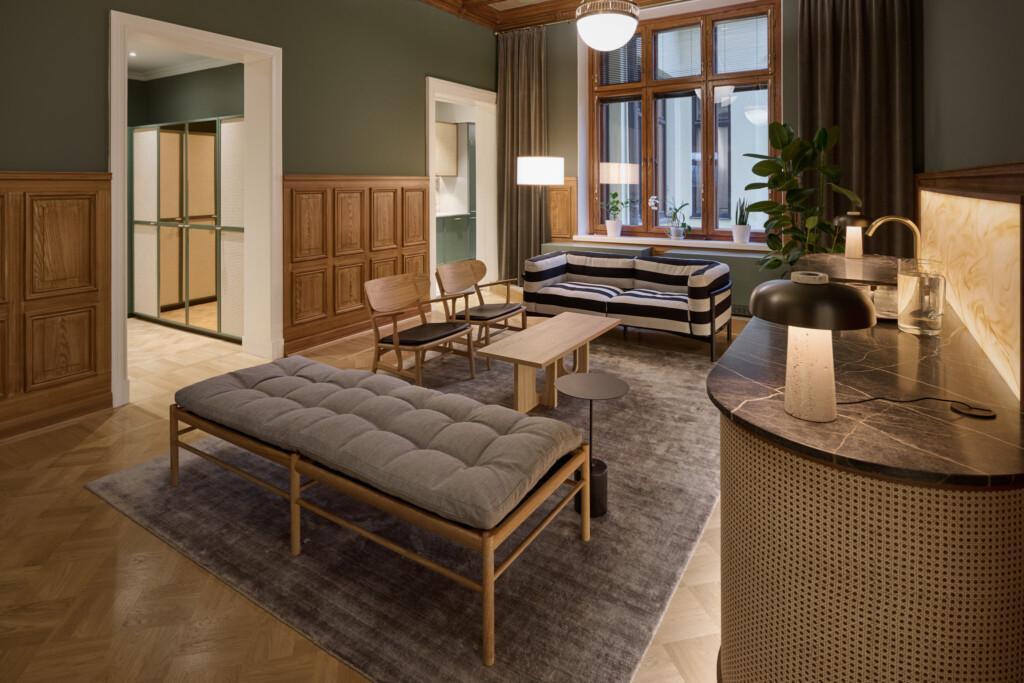
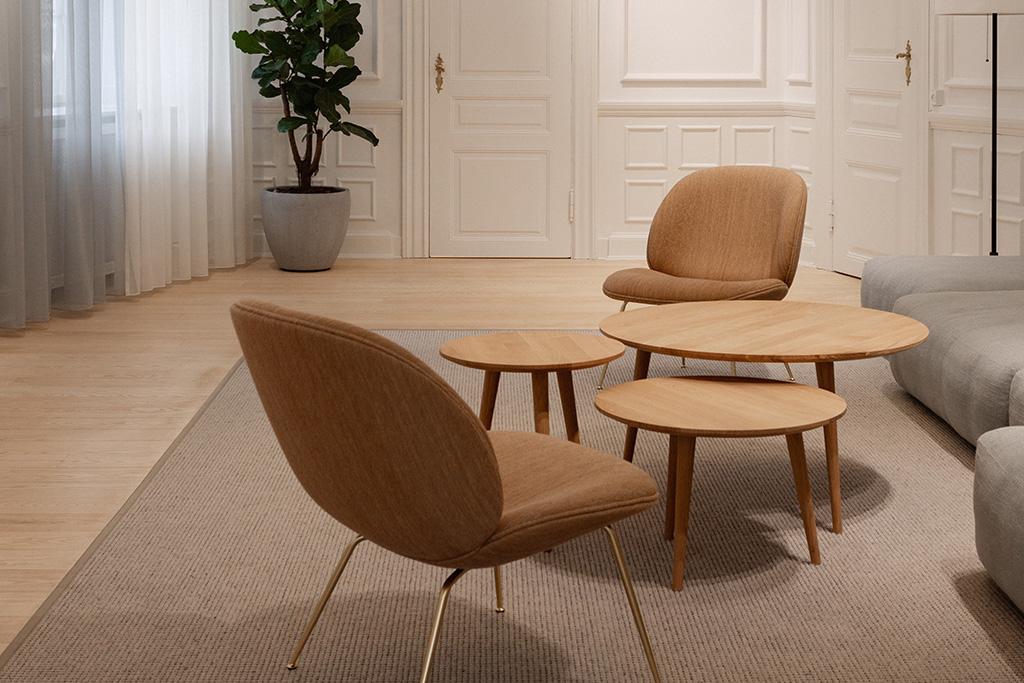
Elegant yet homely office premises for an investment company in central Helsinki.
How to design a flexible work environment that serves different working styles?
Designing a flexible work environment starts with understanding user needs. First, map out the range of different work tasks and working styles in your organization. Identify the levels of concentration, collaboration, and interaction required by the work. Based on this, you can begin to outline a spatial entity that supports diverse working styles and enables smooth transitions between different work tasks.
Utilize zone thinking, where the office is divided into different areas according to their purpose. Concentration areas enable undisturbed work and are acoustically isolated. Collaboration areas, on the other hand, encourage ideation and teamwork in a more open environment. Social areas, such as coffee spaces and lounge areas, serve as meeting places and centers for informal information exchange.
It’s also important to consider future needs in the design. Overly fixed solutions can prove limiting as working methods continue to evolve. Therefore, modularity and adaptability are key to creating sustainable workplace solutions.
What budget is needed for workplace renovation?
The budget for workplace renovation varies significantly depending on the scope of the project, target level, and starting situation. A comprehensive workplace renovation includes design costs, construction work, furniture, technology, and moving costs. Costs are also affected by possible demolition work, building services changes, and surface renewal needs. Notably, good planning saves on overall costs.
Budget distribution in a workplace project typically follows certain guidelines. A significant portion of the budget often goes to construction work and building services. Furniture forms another major expense item, and their price range is wide depending on quality level and ergonomic solutions. Technology investments play an increasingly important role in modern work environments, and sufficient resources should be allocated to them.
Cost efficiency can be improved in several ways. Phasing renovations can spread investments over a longer period. Utilizing existing furniture can bring significant savings, as can improving space efficiency. In workplace projects, it’s also worth examining total costs over a longer period – quality implementation pays for itself through user satisfaction, better productivity, and lower maintenance costs.
| Cost item | Considerations | Cost-saving tips |
|---|---|---|
| Design | Professional design reduces implementation phase risks | Clear goal setting and user needs definition in the initial phase |
| Construction work | Includes demolition and construction work, surface materials | Utilizing existing structures where possible |
| Furniture | Ergonomics, adaptability, and durability affect price | Refurbishing and reusing existing furniture |
| Technology | AV systems, networks, booking systems | Scalable solutions that enable phased expansion |
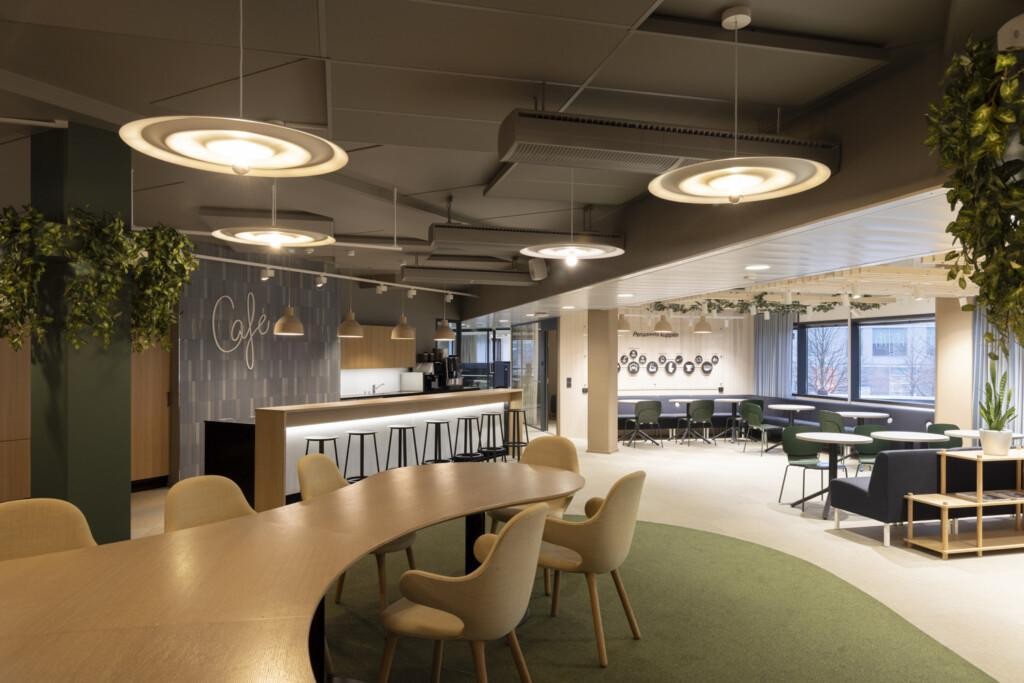
In this workplace project, approximately 70% of the furniture was recycled. The four-pipe office wraps around the staff hub.
How to measure the success of a workplace renovation?
Measuring the success of a workplace renovation is based on clear objectives and diverse metrics. Effective evaluation combines quantitative and qualitative measures that cover space utilization, employee experience, and business perspectives. Measurement should begin before the renovation to map the starting situation, so that the effects of change can be reliably verified.
Space utilization can be monitored in several ways. Sensor-based solutions provide continuous data on the use of different spaces, and booking systems provide information on meeting room utilization rates. These help identify both popular and underutilized areas. Measuring employee experience is equally important and is often done through surveys, interviews, and observation. Key factors to evaluate include satisfaction with the work environment, perceived productivity, and wellbeing.
Impact assessment should also examine business metrics, such as:
- Development of sick leave absences
- Staff turnover
- Recruitment efficiency and appeal
- Space cost efficiency (€/person, €/m²)
- Energy consumption and environmental impact
Measurement should be a continuous process, not a one-time event. Regular monitoring enables continuous development of spaces and working methods. Especially in the era of hybrid work, working methods are constantly changing, and the work environment should be able to adapt to these changes. Long-term monitoring also helps identify trends and anticipate future needs.
Workplace development is a continuous process where success metrics should be tied to the organization’s strategic objectives. When metrics are aligned with the company’s broader goals, the work environment can serve as a strategic competitive advantage and strengthener of work culture.
A well-designed work environment can revolutionize an organization’s operations and employee experience. We design work environments based on deep understanding of our clients’ business, work culture, and future objectives. We combine an analytical approach with creative design so that the end result is both functionally and visually impressive.
Tip! Space utilization can also be measured with the “coffee cup meter” based on coffee consumption!

____________________________________________
Does your space need development? Please feel free to contact us regardless of your project size, and we’ll think together about the best solution for your specific needs!